Outward Odyssey: A People’s History of Spaceflight provides a popular history of spaceflight from the rocket scientists of the 1930s to today, focusing on the lives of astronauts, cosmonauts, technicians, scientists, and their families. These books bring to life experiences that shaped the lives of astronauts and cosmonauts and forever changed their world and ours.
On April 1, 2026, NASA’s Artemis II launched on a ten day mission around the moon, in the first crewed test flight since Apollo. Next year’s Artemis III mission will launch astronauts to Earth’s orbit aboard the Orion spacecraft on top of SLS to test rendezvous and docking capabilities between Orion and commercial spacecraft needed to land Artemis IV astronauts on the Moon in 2028.
Colin Burgess
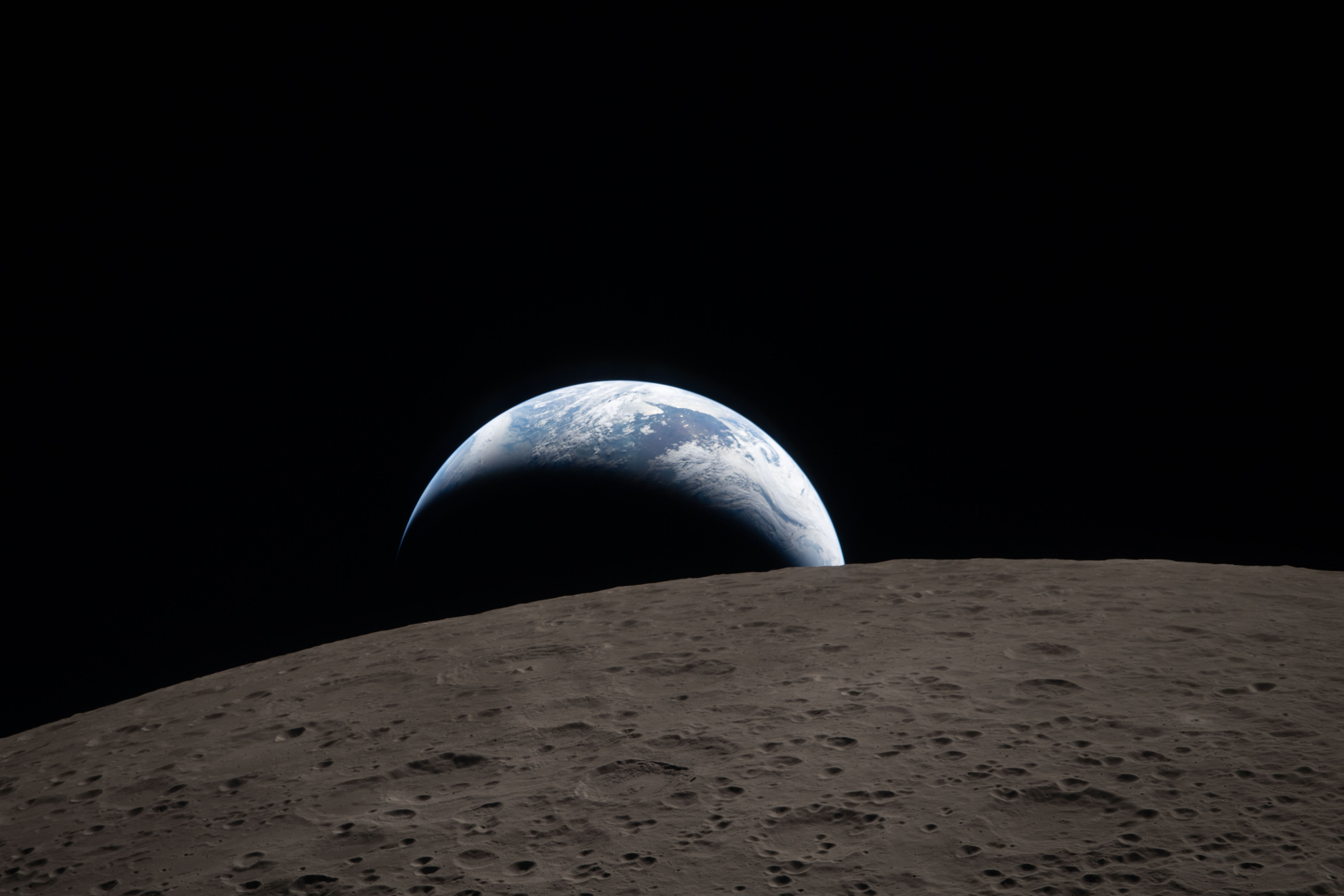
Without question the moon-looping flight of Orion spacecraft Integrity and its diverse crew of four was both a monumental event in spaceflight history and a magnificent success. Nevertheless, I could not help but be struck by the differences between this mission and that of Apollo 8, some 58 years earlier. Back then I recall anxiously waiting for at least a day for the first mission photos to reach the Australian public, and they were grainy at best. I was therefore absolutely astonished at the clarity and spectacular beauty of the photos and footage being streamed from Integrity, and how far spacecraft and imaging technology had evolved. As Jim Lovell and his crew headed for the moon in 1968 there was no such thing as everyday access to the Internet, so for the most part we had to listen for any mission news on our radios and wait for the 6 p.m. news on TV. As well, back in the days of Apollo, we marveled at the first images of our blue planet from space, plus those intriguing photos of the lunar surface snapped by successive orbiting Apollo crews (including that first Earthrise), but those sent back during the flight of Artemis II were absolutely breathtaking. For that alone, this was a truly unforgettable mission.
I grew up in the days of Mercury, Gemini, Vostok, Voskhod and beyond, so my interest has spanned the entire dramatic history of human space flight. I am therefore looking forward to the day—not so far away now—when a new generation of space explorers will set foot back on the moon. Nothing can ever compare to witnessing the triumph of Apollo 11, but after what I experienced during the Artemis II mission, I know that the world is in line for something truly extraordinary.
Colin Burgess is the author or editor of several books on spaceflight, including Shattered Dreams: The Lost and Canceled Space Missions (Nebraska, 2019), Fallen Astronauts: Heroes Who Died Reaching for the Moon, Revised Edition (Nebraska, 2016), In the Shadow of the Moon: A Challenging Journey to Tranquility, 1965-1969 (Bison Books, 2010), and Into That Silent Sea: Trailblazers of the Space Era, 1961-1965 (Bison Books, 2009).
Geoffrey Bowman
Even before Apollo 17 blasted off on the final lunar mission of the twentieth century, I wrote to NASA expressing my youthful distress that all of Apollo’s achievements were being cast aside. I received a serious and thoughtful reply, from Philip Culbertson, NASA’s Acting Director of Advanced Programs. Graciously ignoring the fact that I wasn’t a taxpayer (American or otherwise), he provided me with the NASA corporate line about the Space Shuttle, but in a handwritten postscript added his personal “best guess” that there would be “. . . future manned lunar missions in the late 1980s.” Privately, I thought the Soviet Union would resurrect its N-1 lunar program and put cosmonauts on the Moon by 1979, but the Seventies ended with no fresh footprints in the lunar dust. Then the Eighties came and went. Then the Nineties. By the thirtieth anniversary of Apollo 11 I had become very pessimistic about seeing any return to the Moon (by anyone) within my lifetime.
My hopes were briefly revived by Project Constellation, which called for a return to the Moon by 2020. When Constellation was essentially cancelled, I took my folder of press and magazine cuttings entitled “Return to the Moon” and bitterly wrote on the cover: “File Closed: February, 2010. Sic transit gloria mundi.”
Then, to my surprise, a bipartisan approach to space exploration in the U.S. Congress propelled NASA along a tortuous path to Pad 39B in April, 2026. As I followed the countdown for Artemis II, I recalled my own 53-year path since Apollo 17: school, university, marriage, many travels across our “pale blue dot”, and four decades of legal practice. But I always kept faith with my burning desire to see a resumption of lunar exploration. Five days after the dramatic launch, I watched a live TV transmission as Artemis II prepared to pass behind the Moon. I felt sheer joy. No new footprints in the dust just yet, but Artemis II has made a downpayment for the future. No repetition of tight 90-minute orbits around Earth for that mission! Reid Wiseman’s crew took the road less traveled by, and that will make all the difference.
Geoffrey Bowman is author of A Long Voyage to the Moon: The Life of Naval Aviator and Apollo 17 Astronaut Ron Evans (Nebraska, 2021).
Emily Carney
I’ve been watching launches from Pinellas County, Florida since November 1981, when I saw STS-2, the second Space Shuttle mission, launch from Kennedy Space Center across the state. That mission sparked my obsession with spaceflight, and after that, I tried not to miss any launches—whether they were Shuttle missions or Titan uncrewed launches—from my childhood home’s front yard. At that time, no U.S. women had yet flown to space, and NASA was finally beginning to recruit a more diverse astronaut corps.
Fast forward to April 1, 2026, Artemis II’s launch day. I watched from a fishing pier at one of the three bridges connecting Saint Petersburg to Tampa. Usually alone, I was surprised and pleased by the huge crowd that gathered to witness Artemis II begin its journey. We shouted and whooped in joy as the Space Launch System soared like an orange comet into the early evening sky over Tampa Bay. Back at my car, I realized this launch was unlike any other I’d seen—my first time watching a moon rocket head for deep space, with a woman on board. A strange feeling when you’re pushing 50.
Nearly 45 years have passed since STS-2. Although I no longer live at my childhood home, my family does. I was thrilled to learn that my sister watched Artemis II begin its lunar voyage from that same yard, this time with my nephew, who is now a young adult. Decades pass, people age, but spaceflight stays thrilling and generational. We can’t wait for more moon missions.
Emily Carney is the co-author of Star Bound: A Beginner’s Guide to the American Space Program, from Goddard’s Rockets to Goldilocks Planets and Everything in Between (Nebraska, 2025), with Bruce McCandless III.
Jay Chladek
When working on my last book, Outposts on the Frontier, I attended the launch of STS-135, the last mission of the Shuttle program. At the time it flew, there were plans then for a return to the moon, although the chances for what was then known as the Constellation program were slim to none. Going back to the moon was again going to be shelved due to lack of budget and other priorities. Was there even a point to writing about space if there seemingly was no real destination?
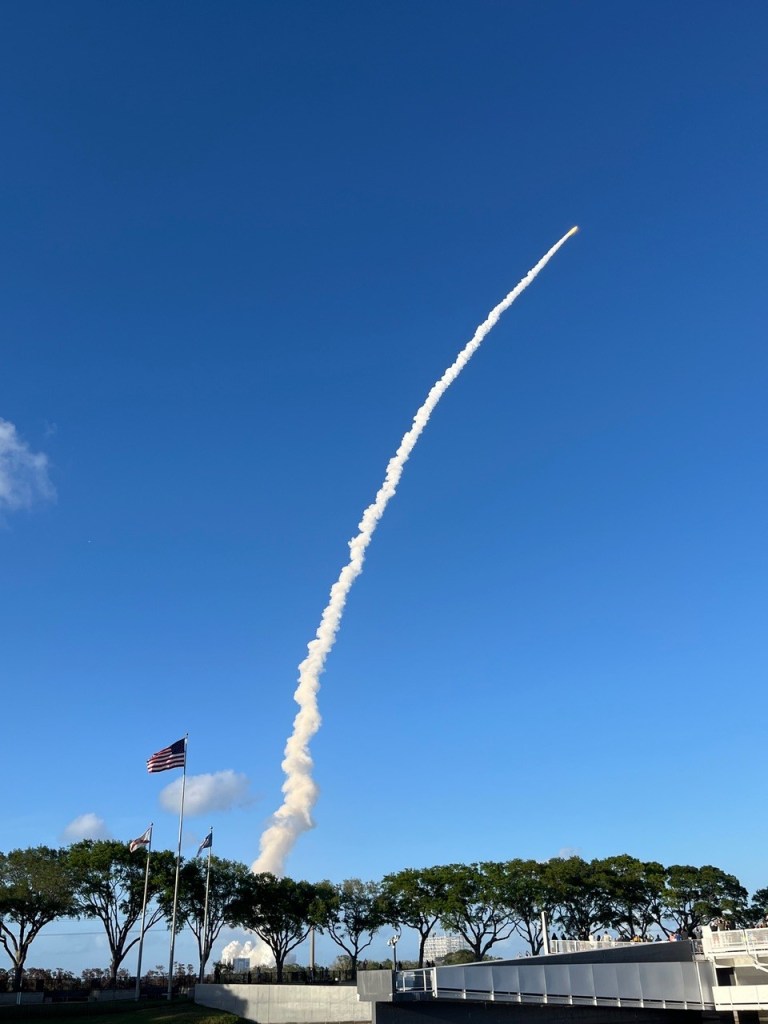
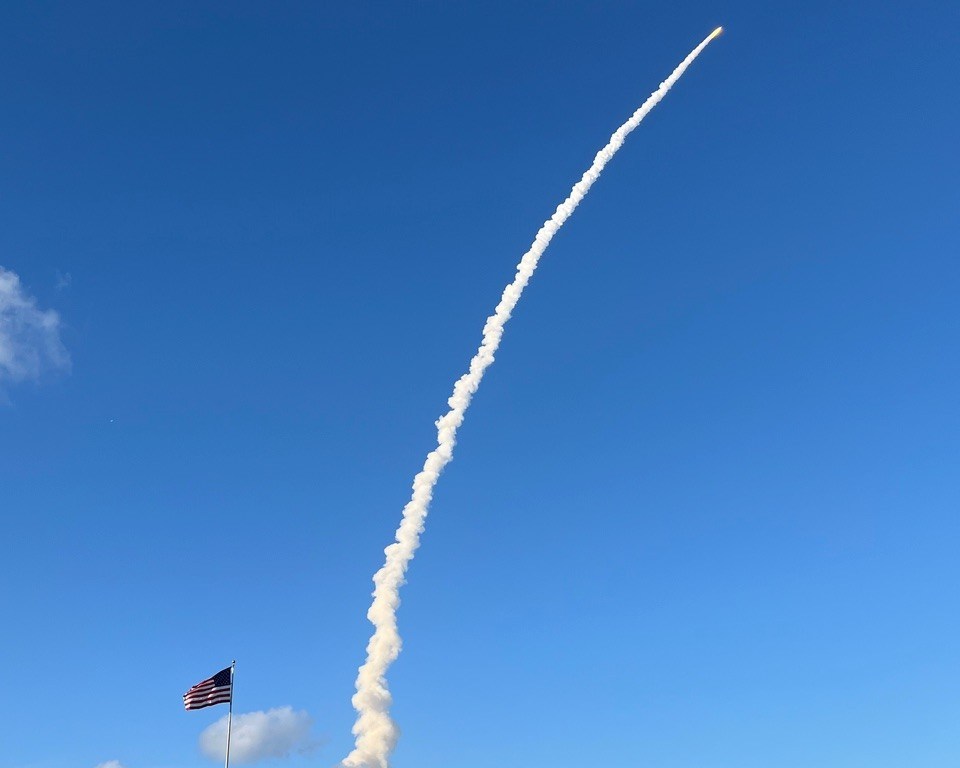
Fifteen years later, Artemis II lifted into the clear blue sky and I was there to witness it. A lunar flyby was planned if all went well. The noise and experience felt very much like shuttle and a bit like an Apollo Saturn V launch I’ve been told. This time, there were potentially more people watching this launch in person who had never seen a Saturn V fly (myself included) than ones still alive who had. But that’s what happens when over five decades pass between Apollo and Artemis missions.
As I stood there enjoying the successful liftoff, I thought back to the engineers and astronauts who wanted NASA to return humans to the moon during those five decades. Budget, timing, and age denied them the opportunity. The majority of active astronauts on NASA’s current roster were born after Apollo 17 flew. You would think time had perhaps dampened enthusiasm for a flight to our nearest celestial neighbor. But no, Artemis II’s crew has shown that the drive is still there among candidates assigned to fly these missions. And more importantly, intense curiosity about Artemis II was also there amongst the general public. To aerospace authors like me who write about such incredible experiences, this helps make the job worth it.
Jay Chladek is the author of Outposts on the Frontier: A Fifty-Year History of Space Stations (Nebraska, 2017).
Melvin Croft
Years ago, when NASA began harboring serious thoughts about returning to the moon, I was at an event with former NASA Flight Director Gerry Griffin where he shared some wisdom with a small group of attendees. It was difficult to go to the moon during the Apollo days, and it’s going to be just as challenging to go back. What Artemis II accomplished is audacious! Just like 55 years ago during Apollo, NASA has the very brightest and most motivated scientists and engineers—the best of the best—that have propelled the United States back into a leadership position amongst world space powers. Since the very first flights into space, those on the ground received little fanfare; the astronauts received most of the glory. Little has changed. To no surprise, the Artemis II crew, Reid Wiseman, Victor Glover, Christina Koch, and Jeremy Hansen, like their predecessors, displayed a huge dose of the Right Stuff. But they brought forth qualities that the original astronauts couldn’t seem to muster; they were able to describe their feelings, give one another high fives, and even hug one another—before, during, and after their flight to the moon—all in the eyes of the world. Hopefully the precedent this crew has set will be the norm for those astronauts who follow, all the way back to the lunar surface and beyond.
Melvin Croft is coauthor of Come Fly With Us: NASA’s Payload Specialist Program (Nebraska, 2019) and a contributor to Footprints in the Dust: The Epic Voyages of Apollo, 1969–1975 (Nebraska, 2010).
Michelle Evans
It has been a long journey to get to this point in the history of space exploration, from Sputnik to the landing of the Eagle on the Moon, and now to finally return. In those early days we proved with just about every flight that nothing was impossible. There were some terrible stumbles along the way, and we paid a high price for those, but overall we traveled in the right direction, and always expected to continue with that progress as we moved humanity out into the solar system. As a young kid while those first steps were happening, I knew with absolute certainty that eventually outer space would open up for the average person in my lifetime. Watching a movie like 2001: A Space Odyssey and thinking how amazing the world would be by that magical year, was something that always fired my imagination. I hoped that I would be a part of all that.
Then in December 1972, everything just stopped. We threw away the technology that got us to the Moon, and decided to instead build Space Shuttles and Space Stations. We insisted that would truly open the path to the planets since infrastructure was needed to sustain such an outward odyssey. Well, we built that low Earth orbit infrastructure all right, but then didn’t utilize it for its intended purpose. Every new political administration changed our priorities, as programs were announced, money spent, then abandoned. Who would have ever conceived that in the past 53 years we would never get our act together to get back to the Moon. I had to abandon my own dreams of spaceflight, but still hoped that maybe someday I would at least see lights on the Moon before I was gone.
Maybe, just maybe, that still might happen, and it was a wonderful thing to finally see humans reach outward again with the flight of Artemis II. The excitement level for myself and my wife ratcheted up as the countdown neared zero, then the rocket finally blasted toward space, and sent four astronauts on a journey around the Moon, literally traveling further from our planet than anyone had ever gone before. The problem now is that I still have to wonder if the planned permanent presence on another planet will happen in the foreseeable future. The schedule is excruciatingly slow, with missions years apart, making them more susceptible to political whims. But at least for one brief shining moment all things did seem possible again.
Michelle Evans is the author of The X-15 Rocket Plane: Flying the First Wings into Space (Nebraska, 2013).
Francis French
For the first time in my adult life . . . the only time I can remember . . . I looked up at the moon and thought, “There are people there.” Such a simple moment, but it carries so much power. For me, that is enough.
Francis French (@F_French) is coauthor of The Light of Earth: Reflections on a Life in Space (Nebraska, 2021), In the Shadow of the Moon: A Challenging Journey to Tranquility, 1965-1969 (Bison Books, 2010), Into That Silent Sea: Trailblazers of the Space Era, 1961-1965 (Bison Books, 2009), and editor of Apollo Pilot: The Memoir of Astronaut Donn Eisele (Nebraska, 2017).
Chris Gainor
As one of the minority of people who are old enough to remember the Apollo flights to the moon from 1968 to 1972, I experienced many powerful pangs of nostalgia during the flight of Artemis II. The broadcasts from inside Orion’s cabin vastly exceeded the short blurry television broadcasts of the Apollo era. But it was the exterior views from Artemis II that vastly and memorably exceeded my expectations.
It all started with Reid Wiseman’s image of the backlit Earth taken shortly after translunar injection. I first saw a reprocessed version that reminded me of many full Earth images from Apollo flights, but close examination revealed much more, including the Earth illuminated by moonlight, auroral displays in the north and south, the glow of zodiacal light, and even stars and the planet Venus in the background. This was a big step up from those Apollo photos with solid black backgrounds that helped fuel questions about the reality of the Apollo flights.
While many of Artemis II’s closeup views of the moon resemble similar images from Apollo, this time they covered previously unseen regions of the lunar far side, including the spectacular Orientale basin.
Perhaps the most breathtaking images were taken while Orion and its crew experienced a solar eclipse as it began its return flight home. Unlike solar eclipses seen from Earth, part of the moon was illuminated by Earthshine, and the moon was surrounded by a halo of light. Scientists are now debating how much of this halo comes from the solar corona or from zodiacal light.
The Artemis II crew also brought home a great image of the Milky Way. Collectively, these photos exhibited how digital imaging exceeds the abilities of the photographic film that was used during Apollo. The full importance of Artemis II is yet to be established, but it can be said that Artemis II has enhanced our knowledge of the Earth, the moon, and even more.
Chris Gainor is the author of To a Distant Day: The Rocket Pioneers (Nebraska, 2013).
David Hitt
“The past,” William Faulkner once wrote, “is never dead. It’s not even past.”
I have had the privilege of writing two books for the Outward Odyssey series: the story of Skylab, and of the early years of the space shuttle.
I traveled to Florida to watch humans begin a journey around the Moon. The echoes of Skylab and shuttle traveled with me.
I made the pilgrimage to Veterans Memorial Park in Titusville, across the river from Kennedy Space Center. I put my hands in the metal cast handprints of my Skylab astronaut coauthors, Owen Garriott and Joe Kerwin. On the other side of the river, the rocket I came to see sat on the same launch pad from which they’d began their journey to America’s first space station.
Forty-five years before my trip, to the month, my father and I watched on TV the first launch of the shuttle. Now, the shuttle’s boosters and engines power a new vehicle, with a new mission. A flag flown on that first shuttle flight flew with the Artemis II crew of Orion. Back home, my father watched another first crewed launch of another new vehicle, this time not with his son, but with mine.
The past is not even past.
I’d never seen humans launch to another world. For decades, I’d awaited the day that they would.
The small step of Artemis II will be followed by another and another, leading to the giant leap of new footprints in the lunar regolith.
A journey that ignited on April 1, 2026.
The future, Faulkner might write of Artemis, is not distant. It’s not even future.
David Hitt is co-author of Homesteading Space: The Skylab Story (Bison Books, 2011) with astronauts Owen Garriott and Joe Kerwin, and of Bold They Rise: The Space Shuttle Early Years 1972-1986 (Nebraska, 2014) with Heather R. Smith.
Richard Jurek
For the first time in decades, astronauts have traveled beyond low Earth orbit to the Moon and returned safely to Earth. It is an achievement I never thought I’d see in my lifetime again. And one I am thrilled to say delivered on all measures.
But this is not just a return to the Moon. It is also a test of whether we, as a space faring people, are ready to make the commitment to keep going, to keep building upon successive milestones.
During the Apollo program, we proved we could reach the Moon under urgency. What we did not prove was sustainability. Apollo was designed for relatively quick success—to achieve a finite goal in a finite period of time—not for permanence. And its dismantling began before we even landed.
If the Artemis program is to serve as a stepping-stone to a lunar base and, eventually, to Mars, sustainability must come first—of goals, priorities, and budgets. It also means shifting focus from missions to infrastructure, from milestones to operations. That’s tough to do with an agency budget that is just 0.33% of the national budget (for comparison, the Apollo program’s peak was 4.5%), and which received a 26% haircut for fiscal year 2026.
Now that we have returned, Artemis must become the answer to a new set of questions, ones forged from the bitter and painful lessons of Apollo: can we make the long-term commitment to the funding and building of a system that can transcend politics and election cycles, and make deep space operations routine, repeatable, and economically viable?
In the shadow of Artemis II’s safe return, that is now my new hope. And, also, my greatest concern.
Richard Jurek is the author of The Ultimate Engineer: The Remarkable Life of NASA’s Visionary Leader George M. Low (Nebraska, 2019).
Christopher Roosa
On April 1, humanity once again sent astronauts around the Moon—and brought them safely home. With the splashdown of Artemis II, a new generation has now felt what only a handful of crews have experienced since the Apollo era: the power of Earth fading into the distance, and the stark, humbling presence of the Moon rising in the window.
For me, that moment is not abstract history—it is personal.
Fifty-five years ago, my father, Stuart Roosa, orbited the Moon aboard Apollo 14 while his crewmates walked its surface. He spoke of the starkness, and the awareness that you are part of something far larger than yourself. The mission was not just a technical achievement—it was a statement about what humanity could do when it chose to reach outward.
Watching Artemis II unfold, I was struck by how familiar that spirit felt. Watching new generations, experiencing the excitement, and the wonder, of space exploration.
The spacecraft is new. The technology is more advanced. The world watching is more connected. But the core emotion—the quiet courage of the crew, the collective breath held during critical moments, the pride at splashdown—remains unchanged. It is the same thread that runs from Apollo to Artemis.
This mission matters not only because it succeeded, but because it restores continuity. For decades, the path beyond low Earth orbit felt paused, almost like a story unfinished. Artemis II picks up that narrative and carries it forward—not as nostalgia, but as momentum.
My father’s generation showed us that reaching the Moon was possible. Today’s astronauts have reminded us that it is still within our grasp—and that it is only the beginning.
The Moon is no longer a destination we once conquered. It is, once again, a horizon calling us forward.
Colonel Christopher Roosa, USMCR (Ret) is the author of Son of Apollo: The Adventures of a Boy Whose Father Went to the Moon (Nebraska, 2022).
John Youskauskas
I had the opportunity to meet Victor Glover at an event last year, where we spent a few minutes discussing his upcoming flight to the moon. If he had any trepidation, it was the forty minutes or so that the crew of Artemis II would be behind the moon, out of contact with the rest of humanity. There would be them, out there, and the rest of us, back here, visually and electronically separated by the moon. “We haven’t done that in a very long time,” he said.
My wife and I attended the launch and listened to the customary farewells over the radio as the tense final minutes passed. But when Commander Reid Wiseman ended his crewmates’ goodbyes with “Your Artemis II crew is go for launch. Full Send!” it kind of stunned me. The confidence expressed in those two final words wasn’t trivial. Four astronauts were about to ride the most powerful rocket ever crewed, and they were headed into deep space, yet any doubt was put out of their minds long before. Their trust in the international team that built that spacecraft and placed them in it was absolute.
The crew is home now, and they are still coming to grips with what they witnessed on their incredible journey. They took us all along for nearly ten days in ways impossible during Apollo, with commentary, video, and stunning still photos beamed down during the mission. But in several instances since returning, they have deferred speaking about certain aspects of the flight, as they are still trying to mentally process it all. Often, the loss for words is accompanied by tears.
After five decades, there are no longer just twenty-four humans who have been to the moon—now there are twenty-eight, and it’s about time. Reid, Victor, Christina, and Jeremy have been incredible bearers of that torch for this new generation. I look forward to the stories they have yet to tell.
John Youskauskas is coauthor of Into the Void: Adventures of the Spacewalkers (Nebraska, 2025) and Come Fly With Us: NASA’s Payload Specialist Program (Nebraska, 2019).