Joanna Beata Michlic is a social and cultural historian of the Holocaust and its aftermath. Her research focuses on Jewish childhood, rescue, and the long-term impact of genocide. Michlic is author, editor, and coeditor of numerous books, including Poland’s Threatening Other: The Image of the Jew from 1880 to the Present (Nebraska, 2006) and Bringing the Dark Past to Light: The Reception of the Holocaust in Postcommunist Europe (Nebraska, 2013). Her new book Through the Eyes of Jewish Child Survivors from Poland: Family, War, Identity, and Nationhood (Nebraska, 2026) was published this month.
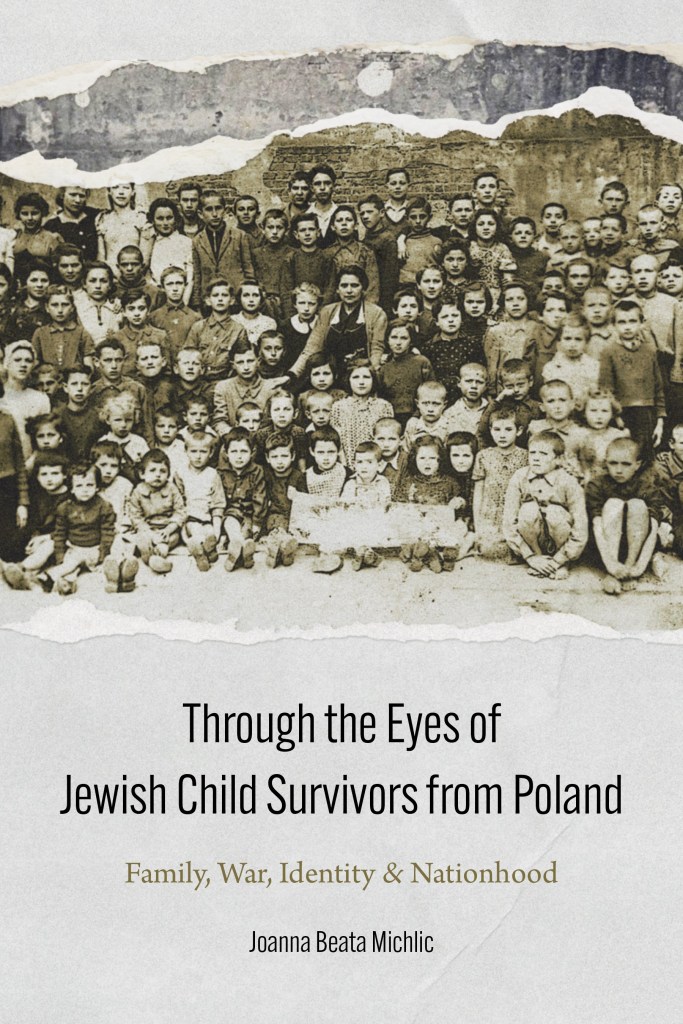
In writing Through the Eyes of Jewish Child Survivors from Poland, I returned again and again to a deceptively simple question: what does it mean to “rescue” a child during genocide? The more closely I listened to—and analyzed—the voices of Jewish child survivors, the more this seemingly clear category revealed itself as complex, fragile, and morally unstable.
Rescue was not always a heroic act or activity. It could be a long and painful relationship, shaped by fear, dependency, money, affection, exploitation, and, at times, physical, emotional, and sexual abuse. At the same time, older Jewish children hidden by individual non-Jewish Poles were not merely passive recipients of adult decisions and actions. Even in the most extreme genocidal conditions, they acted, observed, calculated, adapted, and struggled to survive.
Children living “above the surface” in local Polish communities often actively supported their rescuers in the daily practice of concealment. They learned—often the hard way—to perform, convincingly and without error, the role of Catholic Polish children. In some cases, boys were required to adopt a double disguise, pretending to be girls—playing with dolls and imitating girlish language and behavior. Their agency was undoubtedly constrained, but it was real, resourceful, and essential to their survival in a hostile social environment.
One of the central arguments of my book is that we need a new typology of rescue—one that reflects the complexity and diversity of rescuers and moves beyond the simplistic binary of the “good rescuer” (the Righteous) and the non-rescuer, a framework still too dominant in Holocaust education. Such a typology may also be useful for analyzing other cases of genocide and mass violence, where children’s survival often depends on unequal, unstable, and morally ambiguous relationships with adults.
The case of Zofia Boczkowska illustrates what I would call genuine rescue. Zofia and her husband, Stanisław Boczkowski, sheltered Mery Baron, a Jewish girl born in 1937 in Lwów (today Lviv in Ukraine), as well as another Jewish child, Janka Stiglitz. By the time Zofia encountered her, Mery had already endured a series of traumatic experiences, including an attempted drowning by a Ukrainian woman entrusted with her care. Zofia found Mery in a horrifying scene: barefoot, neglected, and forced to dance for the amusement of German soldiers, while nearby Jewish adults were forced to dig their own graves.
Acting with courage and presence of mind, Zofia bribed German gendarme, constructed a false non-Jewish identity for Mery, and brought her into her home. Crucially, rescue in this case did not end with the act of saving Mery’s life. The Boczkowski couple provided her with love, care, physical protection, and emotional stability over an extensive time.
After the war, Mery’s relatives in Tel Aviv sought to bring her to Israel, but they also recognized the depth of her emotional attachment to the Boczkowski family. They understood that her return to Jewish identity would need to be approached gradually and with sensitivity. For Mery, Jewishness had become associated with danger, the murder of her parents, and profound loss and trauma. She therefore remained with the Boczkowski family into young adulthood before eventually moving to Israel and reconnecting with her remaining biological family. This case shows us that genuine rescue extends beyond physical survival to include a sustained commitment to the child’s emotional and psychological well-being.
Yet not all rescuers resembled Zofia Boczkowski. The testimony of Lena Atlas, born in Lublin in 1937, reveals a starkly different reality. Writing as an eleven-year-old in a Jewish children’s home in 1948, Lena described her wartime experiences in hiding with remarkable clarity. Her rescuers saved her life, but they did not protect her childhood.
Under the care of her first rescuer, a farmer near Lublin, Lena was denied affection, care, adequate food, safety, and dignity. She was treated as an unpaid servant, forced to perform heavy labor, beaten, humiliated, and fed only leftovers. Her clothes were taken from her and worn by the farmer’s daughter in front of her, while she herself was excluded even from basic forms of childhood interaction, such as play with the farmer’s daughter.
Her second rescuer, Sabina Bojanowska of Lublin, presents a more complex case. Bojanowska attended to some of Lena’s basic needs and occasionally displayed gestures of human decency. As a result, Lena developed a deep emotional attachment to her. Yet Bojanowska also exploited and degraded her. After the war, when Jewish representatives attempted to place Lena in a Jewish children’s home in Lublin, Bojanowska refused to release her without financial compensation. Only after prolonged negotiations did she allow the child to leave, reportedly remarking: “Now you can go to the dirty Jews.”
Lena’s later reflections help us understand this relationship as a trauma bond. Her attachment was not grounded in secure love but in dependency, fear, and gratitude for survival. Thus, Bojanowska was also both rescuer and abuser. She belongs to a category we must acknowledge if we are to understand children’s experiences truthfully and fully: the rescuer-abuser. Of course, Lena’s first rescuer, the farmer near Lublin represents a case of extreme rescuer-abuser.
The case of Jakub Golsztajn (the late Yaacov Goldstein) introduces another crucial dimension: children’s agency. I first encountered Jakub through a letter he wrote from a hospital in Tworki, near Warsaw, where he was placed with other injured Polish civilians, after the Warsaw Uprising of August 1944. At the time, I did not know of his complex survival account beyond the letter that I had discovered in the archives of the Jewish Historical Institute in Warsaw. Only when watching the powerful 2025 award-winning documentary Among Neighbours directed by Yoav Potash, did I realize that the ten-year-old boy who authored the letter—whom I had searched for in vain because of a lack of sufficient information—was the same Jakub who, as a mature adult in the film, reflected on his postwar miraculous reunion with his surviving parents and the family’s subsequent tragic history.
This discovery came when my book was already in print, and it reaffirmed for me how historical research evolves—through new sources, unexpected encounters, and connections across different media. It also deepened my understanding of children’s agency and resourcefulness.
Jakub had been hidden in Warsaw by the Zieleniak family, who were related to Mr. Gawron, a farmer and an acquaintance of Jakub’s parents before the war. His parents paid for his upkeep, making this a case of rescue for profit rather than altruism. The Zieleniak family did not care adequately for Jakub’s physical and emotional well-being, though he experienced some moments of kindness as one of their daughters, Jadwiga brought him books every day from the library, and Jakub remembered this fondly in the film. For a hidden child confined, for days and nights, to a tiny space without ability to move, books could provide more than distraction; they offered an inner world and a vital means of emotional survival.
In the aftermath of the defeat of the Warsaw Uprising, the Zieleniak family left Jakub behind in their apartment without explanation. As I argue in the book, fear of being denounced as a family hiding a Jewish child to the Germans undoubtedly played a role in their decision to abandon him. A few days later, after the apartment building was bombed, Jakub managed to escape to the courtyard. He was located and picked up by German soldiers who did not recognize him as Jewish, and was eventually transferred to the hospital in Tworki. In the middle of January 1945, Jakub, who still then pretended to be a Polish Catholic boy, named Jan Wieczorek, wrote a note addressed to Mr. Gawron. The note was accompanied by a letter to his parents informing them of his survival and hospital stay. Jakub strongly believed that his parents had survived the Holocaust and returned to their hometown, Gniewoszów to search for relatives.
The letter was carefully composed. Jakub could not openly criticize the Zieleniak family who had hidden him because Gawron, their close relative, remained his only possible link to his birth parents. His self-censorship was a clever strategy. It was a child’s intelligent, disciplined effort to be reunited with his family. Jakub’s letter reflects what I define as constrained agency: the ability of children to make decisions and act purposefully within severely limited and dangerous circumstances. And this letter paid off, Jakub and his family were ultimately reunited. However, in the aftermath of the war, his parents, maternal uncle Eliyahu, and two other Holocaust survivors were brutally murdered in their prewar home in postwar Gniewoszów. Jakub escaped this collective murder, carried out by members of an extreme right-wing Polish underground military formation, only because he had already been relocated as the first family member to a new apartment in Łódź—the vibrant center of Jewish life in early postwar Poland. His parents and the remaining family members were preparing to join him there shortly afterward. The devastating news of their murder, conveyed to Jakub by his father’s uncle, Abraham Liebhaber, shattered the boy’s fragile hopes for the restoration of family life after the war. Despite all the dangerous and ultimately successful struggles his parents had endured to survive the Holocaust and reunite with their surviving son, Jakub became an orphan.
Together, these accounts show why we need a more precise typology of rescuers. We need to distinguish between genuine rescuers, rescuers for profit, ambivalent rescuers, and rescuer-abusers and rescuer-perpetrators. These categories are not always fixed. They sometimes may overlap. But without them, we risk flattening children’s experiences into comforting stories that obscure exploitation, fear, abuse, crime, and postwar trauma.
To write the history of Jewish child survivors is to listen carefully to complexity. It is to acknowledge both vulnerability and agency, both rescue and harm, both gratitude and pain. Above all, it is to restore the full depth of children’s wartime and postwar experiences and to recognize them not as symbols, but as historical actors whose voices continue to challenge us to think more honestly and truthfully about survival, morality, and human behavior under genocide.
 UNP blog
AS BOTH, HISTORIAN AND CHILD SURVIVOR I WHOLEHEARTEDLY
SUPPORT THE AUTHOR’S APPROACH TO THIS SIGNIFICANT
ISSUE. IT IS VERY IMPORTANT TO EXAMINE THE EFFECTS OF
SPECIFIC CONDITIONS AND CIRCUMSTANCES OF SURVIVAL.
THEY AFFECT OLD SURVIVORS EVEN IN THEIR EIGHTIES
AND NINETIES.