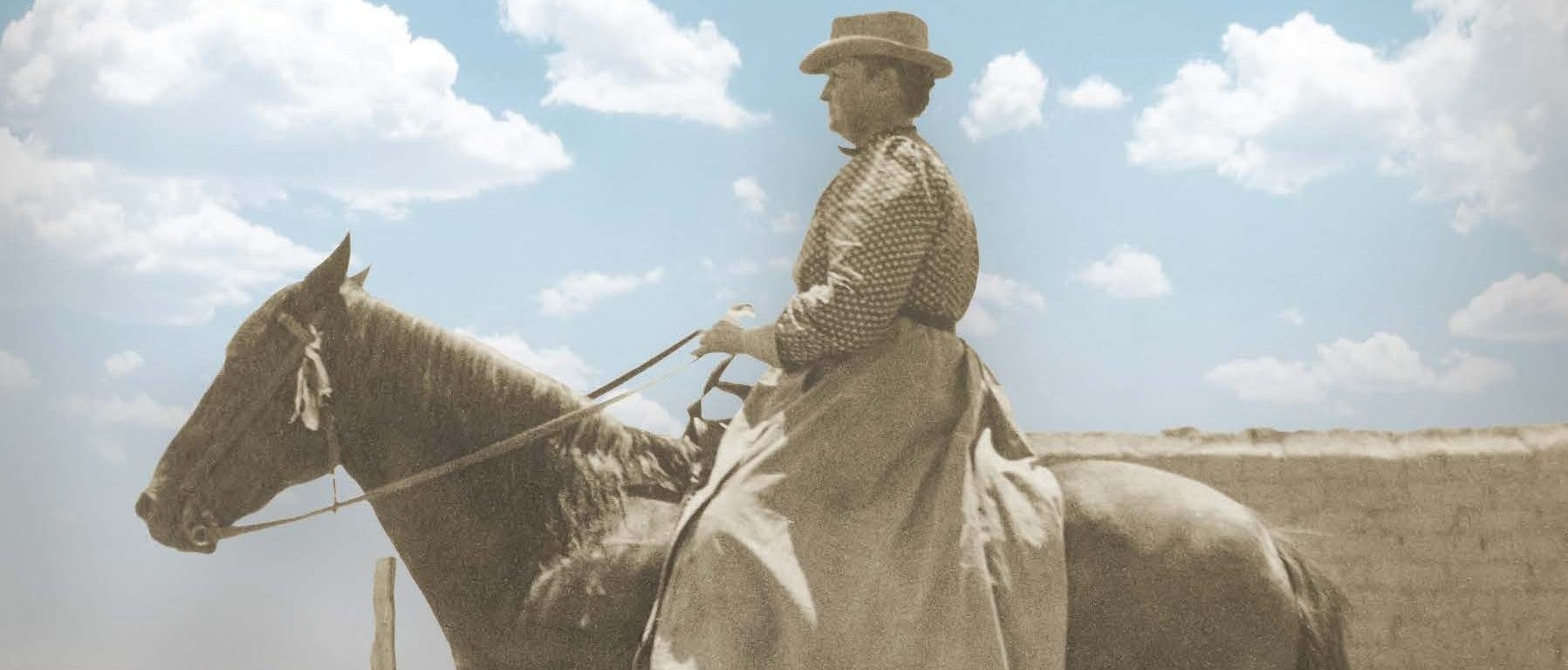
Valerie Sherer Mathes is professor emerita of history at City College of San Francisco. Mathes has written eight books, three with co-authors, and edited four others, all on some aspect of the late nineteenth century Indian reform movement with an emphasis on the role of the Women’s National Indian Association (WNIA). Her most recent book, Mary Louise Eldridge: Missionary and Field Matron to the Navajos (Nebraska, 2026), is a history of the reform efforts of a New England woman whose work was supported by the Cambridge and Connecticut auxiliaries of the WNIA.

The Women’s National Indian Association (WNIA) emerged in 1877 from within a women’s home missionary society of Philadelphia’s First Baptist Church and remained active throughout the Indian reform movement until disbanding in 1951. In 1883 the WNIA began founding missionary stations on various Indian reservations, more than sixty in total. My historical journey started with their establishment of the Ramona station among the Mission Indians of Southern California founded to continue the legacy of Helen Hunt Jackson, author of A Century of Dishonor and Ramona. Jackson was the subject of my dissertation which was published in 1990 by the University of Texas Press. Decades later my research on the WNIA led me to Mary Louise Eldridge, nurse, missionary, government field matron, and the supervisor of half a dozen WNIA stations on the Navajo Reservation.
In 1891 Eldridge and Mary E. Raymond were sent by the women’s missionary society of the Methodist Episcopal Church to Jewett, New Mexico to establish a mission and school among the Diné (Navajos) living along the San Juan River. After six weeks of tent living, a small wooden structure was constructed for them on the north bank of the river. This facility, the Navajo Methodist Mission, grew to include several small structures, living quarters, and a boarding school. In 1899 Eldridge supervised the adjacent construction of the Rebecca Collins Memorial Hospital, a barn, and a free-standing industrial building for the WNIA. In 1902 the school was moved from Jewett to near Farmington. It was destroyed in the 1911 flooding of the San Juan. Rebuilt on higher ground, today it is the site of a Navajo Nation preparatory school.
As a field matron, Eldridge was tasked with instructing Indian women in traditional white housekeeping skills including sewing, laundry work, preparation of proper meals, and the care of children and domesticated animals. Field matrons were also encouraged “to give to the male members of the family kindly admonitions as to the ‘chores’ and heavier kinds of work about the house which in civilized communities is generally done by men.” In addition, Eldridge ran a cottage industry, encouraging the women in weaving their unique blankets, supervising them in sewing clothing for their families on machines and baking bread in ovens provided in her industrial building adjacent to the hospital and in subsequent industrial rooms in future stations. Funding for such rooms was provided primarily by the Cambridge Indian Association, a WNIA auxiliary. Raised on a farm, Eldridge also worked with Navajo men, providing them with seeds, grape vines, fruit trees, and equipment and supervising them as they dug and expanded the Cambridge Ditch from the San Juan River to water their fields.
Most of the time, however, she spent feeding starving Navajos, often using her own meager salary; nursing the sick; burying the dead; and vaccinating against smallpox. To visit local patients, she rode a horse, her saddle bags full of medicine. For more remote camps, she loaded one of her several wagons with medicines, water, hay, seeds, and clothing and headed out on the reservation. At one point she lived for months in a twelve-by-sixteen-foot tent in a remote camp at El Huerfano, assisting government agents as they allotted public land to Navajos. This book traces Eldridge through six different mission stations.
In writing it, at least on paper, I was able to learn more about a state where I lived as a child and later attended university. I also learned more about the history of the Navajo Reservation which I have visited often. As a historian, I am proud to tell Eldridge’s story through her own letters, reflecting her perspective, avoiding the all too common ‘sin of presentism.’
Eldridge described her work as follows. “I dreamed when I came here of a great work for these people, when they should be gathered into schools and churches, but now I am busy just trying to help them to a better, more comfortable temporal life, trying to help them carry their burdens, caring for the sick and old, getting them to send their children to school, and as opportunity offers, telling them of the future so dear to every heart—where all tears shall be wiped away. Someone must do this work which, if I neglect, no one else will do.” Her activities prompted one historian to describe her as a nurse, irrigation project civil engineer, farmer, trader, fund raiser, hospital administrator, cottage industry entrepreneur, policy advocate, and adoptive mother to Navajo children, roles far beyond what the government had envisioned for a field matron.
Eldridge’s legacies are many, including the continuation of a school she helped to found in 1891 in Jewett, and the fact that numerous Navajo families, out of respect, have adopted either Eldridge or Cambridge as surnames. Mary Louise Eldridge was truly a remarkable nineteenth century woman and I am pleased to be able to tell her story.

