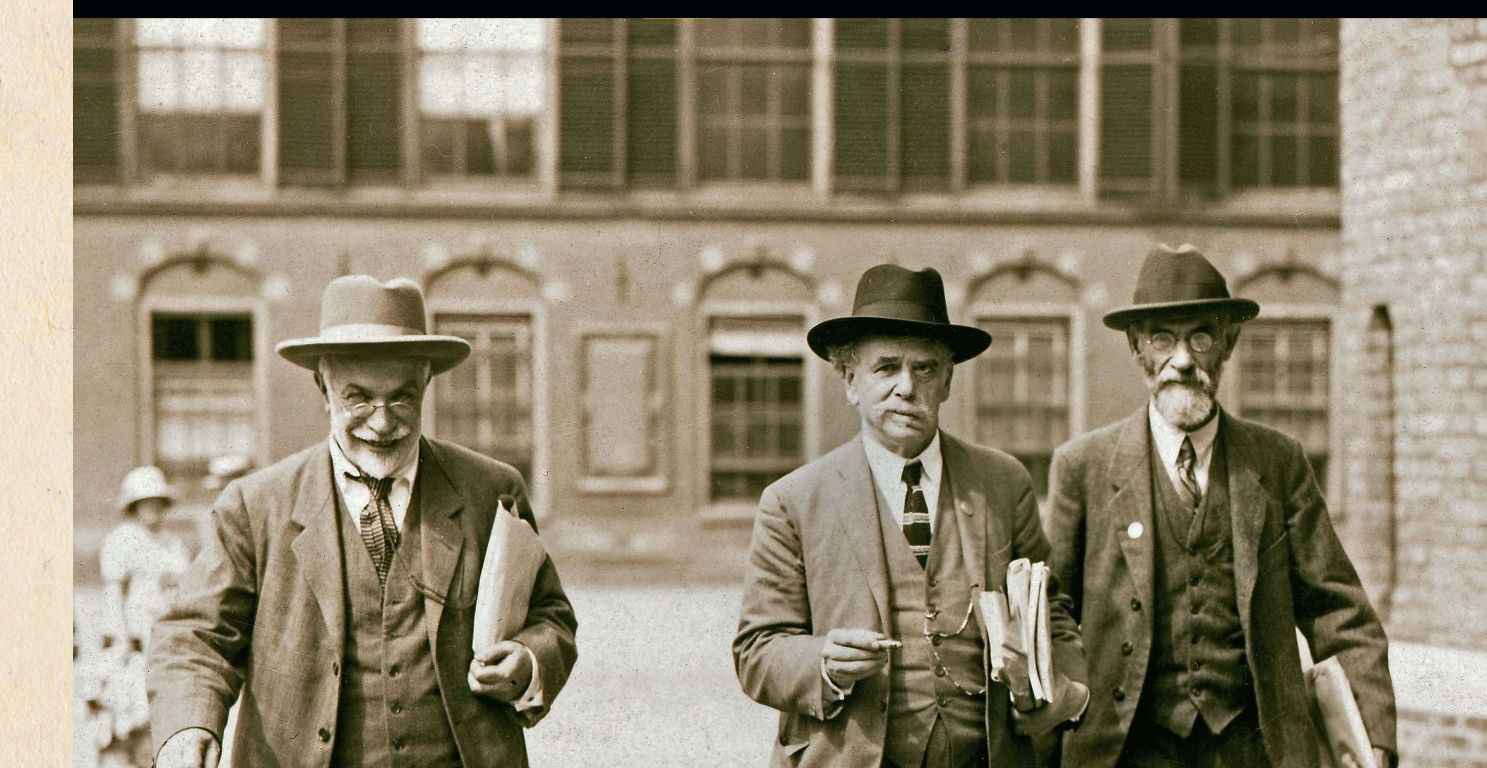
Dima Arzyutov is a historical anthropologist and Assistant Professor in the Department of Slavic and East European Languages and Cultures at Ohio State University. His research examines Arctic and Siberian Indigenous histories in relation to the critical assessment of the production of anthropological knowledge, as well as archives and museum collections. He is coeditor of The Franz Boas Papers, Volume 3 (Nebraska, 2026) alongside Sergei A. Kan, Laura Siragusa, and Alexander Pershai which was published in July.
An anthropologist in the archive of another anthropologist: what is one looking for in order to better understand both the history of thought and the time in which the scholar lived? The answer, most likely, lies in letters—those sheets of paper inscribed with ink, filled with emotions and thoughts, and serving as windows into the inner workings of anthropology, revealing how the key texts all anthropologists know, and the legends they share, came into being.
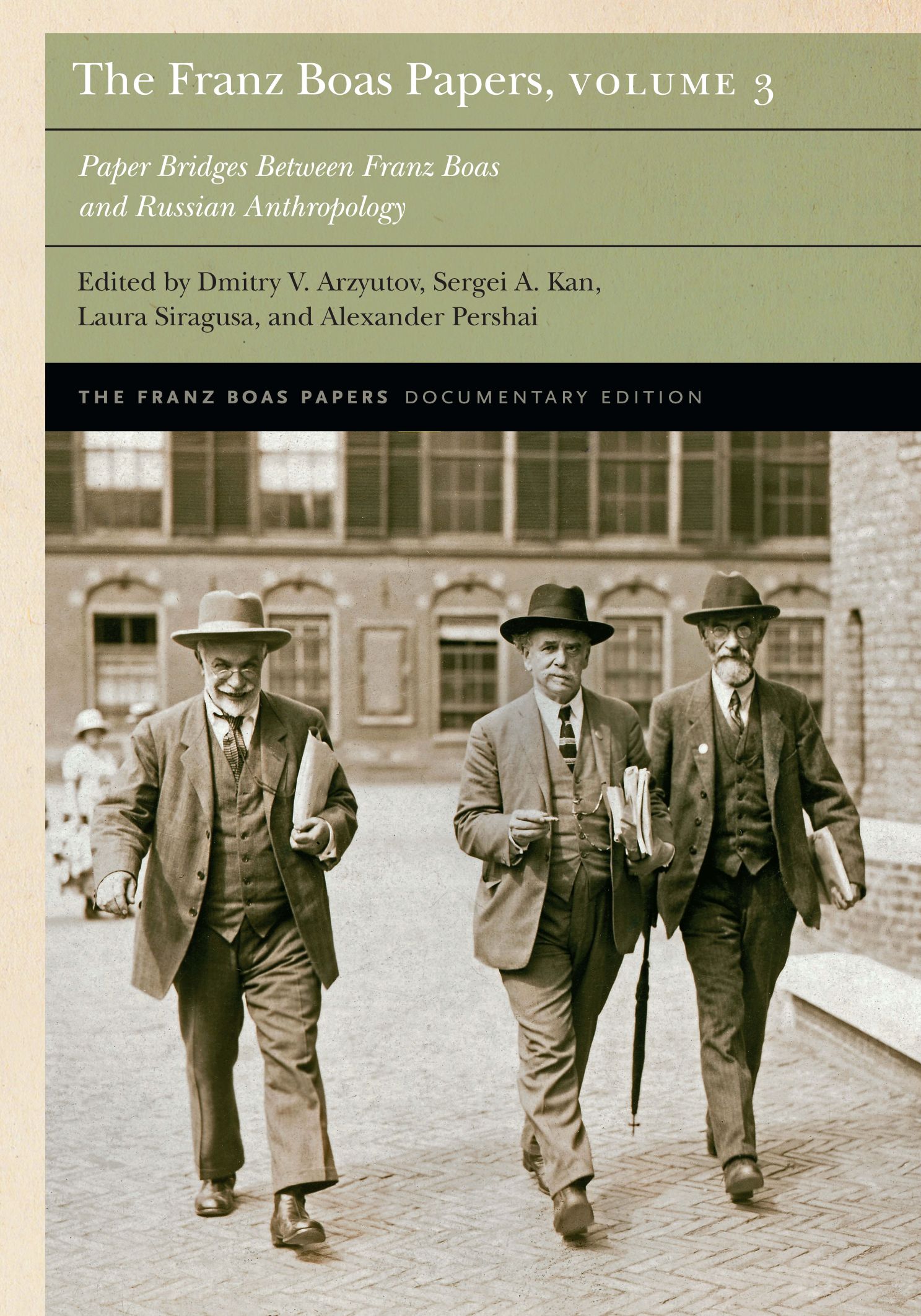
With this in mind, three other editors of this volume and I embarked on this journey to reconstruct the “Russian” history of Franz Boas, one of the founders of American anthropology. The project was initially launched by Sergei Kan within the broader project led by Regna Darnell, The Franz Boas Papers, sponsored by the Canadian Social Sciences and Humanities Research Council and aimed at publishing a multi-volume edition of almost all of Boas’ correspondence. Sergei was able to convince Regna that the Russian dimension of Boas’ intellectual history was vital for understanding both his contribution to the history of Arctic anthropology and his political biography, although this dimension had not originally been envisioned as part of the project. At an early stage, and at the request of both Sergei and Regna, leadership was transferred to me, and together we assembled an editorial team consisting of Sergei, Laura Siragusa, Alex Pershai, and myself.
At that point, none of us knew that we would visit—both in person and virtually—more than thirty archives across the United States, Russia, Norway, and France over the course of six years, the time we spent on this project, in order to reconstruct the vast network of correspondence linking Boas with numerous anthropologists and political figures in Imperial and Soviet Russia. Throughout these intellectual and physical journeys, we relied on the support of many colleagues and friends, to whom we express our sincere gratitude in the preface.
As we mapped these networks, we came to realize that what emerged resembled something all of us had encountered as students of history, anthropology, philology, and sociology: the Res Publica Literaria—that Renaissance and Early Modern intellectual formation through which scholars built networks through letters, journals, and the earliest learned societies. Although that epoch may seem long past, in the early twentieth century the nascent discipline of anthropology confronted new divisions: world wars and ideological boundaries. To overcome those divides, anthropologists relied on something remarkably similar: a new Res Publica Literaria, which in our story coalesced around the towering figure of Franz Boas.
Focusing predominantly on letters, we sought to demonstrate the extent to which their materiality and trajectories across time and space can help us reimagine the life of anthropology: how letters constituted the boundaries of intellectual “clubs”; how they connected scholars across field sites, offices, and even prison cells; how they saved lives; and how they could, conversely, destroy dreams. These relations—personal, political, and intellectual—constitute the body of this volume.
To embrace that diversity, we organized the volume around several “paper bridges”: the different directions taken by Boas’s networks in Russia and slightly beyond. Boas appears here in multiple dialogues. First, with what is known in the history of Soviet anthropology as the “ethnotrio”—three Russian Jewish revolutionaries turned anthropologists of the Arctic and Siberia, two of whom contributed extensively to the Jesup North Pacific Expedition, and all three to research on the Chukchi, Nivkh, Sakha, Yukaghir, and other Indigenous groups of the Russian Far East. They became among Boas’s closest intellectual companions: Waldemar Bogoras, Waldemar Jochelson, and Lev Shternberg; their names are transcribed as they appeared in their English-language publications. This predominantly male intellectual milieu was only marginally broadened by the presence of the ethnotrio’s wives, and the surviving correspondence with them remains comparatively limited.
Second, there was a bridge to Boas’s students who either came from Russia or whom he sent there—Julia Averkieva, who adored Boas and called him “Papa Franz,” and Archibald Phinney, the influential Nez Perce anthropologist who was trained within early Soviet Marxist anthropology and who, upon returning to the United States, contributed to the development of the Indigenous rights movement.
The third bridge concerned Boas’ exchanges with Soviet journalists, politicians, and public figures. On the one hand, he grew increasingly skeptical of Soviet politics as reports of Stalinist repression reached American intellectual circles. On the other hand, with the outbreak of the Second World War, he could not remain indifferent to the atrocities unfolding in Europe or to the ideological disillusionment he experienced, as a left leaning intellectual, in relation to Soviet socialism.
And finally, the volume contains quite a few “discoveries”—from Boas’s involvement in the ambitious but ultimately unrealized project of a Sámi expedition to the Kola Peninsula initiated by famous Norwegian explorer Fridtjof Nansen (the photograph of whom we published in the book, although for a moment I considered using a different picture—one surrounded by an oddly funny story), to the discovery of a truly unique phonographic recording of Archibald Phinney, the story of which was reconstructed by our colleague Svetlana Podrezova and published as an Appendix. Arctic anthropologist and museum curator Igor Krupnik, in turn, kindly agreed to write an Epilogue in which he situates Boas within the complex political relations that shaped the final years of his life.
Each direction within this vast archive raised difficult questions for us as scholars living in the twenty-first century. New ideological divisions and the incomprehensible military violence of Russia—the native country of two of the four editors—against Ukraine—the native country of two members of the ethnotrio—cannot but bring us back to the formative era of American and Russian anthropology, when scholarly correspondence could sustain intellectual life across borders and political divides.
When this essay had been completed and was about to be sent to the University of Nebraska Press, I decided to experiment with ChatGPT and asked it to compose a relatively short poem about the story our volume tells. I was rather specific in my request and asked it to echo the styles of Joseph Brodsky and his beloved poets, John Donne and W. H. Auden on the “Russian” Boas saga. It seems the “poetry” turned out rather well and may even bring a bit of joy—and perhaps a smile—in response to AI-generated stereotypes:
No empire lasts. Not snow, not seal, not rail.
Only a folded page survives the weather—
ink drying somewhere in New York,
read months later where dogs sleep in the traces.
One man addresses another. Dear friend—
and all geography grows suddenly negotiable.
The ocean shrinks to paper,
history becomes a margin, revised in violet.
Who taught us knowledge lives in institutions?
Not these men. They trusted envelopes,
the slow republic of delayed replies,
where friendship bore official seals.
A hand in Petersburg pauses.
Another, across the water, unfolds the pause
and calls it science.
So bridges are not built of stone after all.
Only of sentences sent too far
to remain private,
and too human not to arrive
 UNP blog