
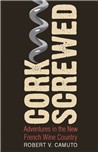
 Read from the introduction of Corkscrewed: Adventures in the New French Wine Country by Robert V. Camuto:
"It was a perfect day to lose faith in wine. By midmorning on June 21, 2005, the heat and humidity were conspiring to make it another in a series of stifling hot days in Bordeaux. I’d set out from Saint-Émilion in my tiny Citroën rental car—windows rolled down to make up for the lack of air conditioning—en route to Vinexpo, the world’s largest wine convention held once every two years in the sprawling convention site north of the city.
As I inched along in traffic across the bridge on the Gironde River, I was thinking about the schizophrenic state of the French wine industry, which—if you believed the French—was in a state of inescapable crisis. Winemakers were rioting in Languedoc, furious over global competition and circumstances beyond their control. French people were drinking less, having ceded to the Italians their place as the world’s biggest wine drinkers. While Americans were learning from study after study about the positive effects of red wine, French government health campaigns were targeting their countrymen’s overconsumption. (To show just how serious the Republic was about cutting down on drinking and driving, gendarmes were going after the once-sacrosanct Sunday lunch crowd by staking out traffic circles across the countryside.) French wine by the tanker was going unsold, and prices of run-of-the mill wines were collapsing as the once-untouchable French wine industry appeared to be drowning in foreign wines from places like Chile, where French winemakers had taken their savoir faire. Even French actor, winemaker, and bon vivant Gérard Depardieu was quoted in news articles saying he hadn’t had a drink in six months! As for the French intellectuals,what could they do but write essays proclaiming the end of France’s wine glory?
Yet, in a seemingly cruel and simultaneous twist, the forces of globalization were inflating prices of the grandest of Bordeaux’s grand crus, wines that were already out of the reach of most mortals. Bottles of most anything French and expensive were being snapped up as status symbols—like luxury watches—by freshly minted millionaires in Russia and China who, it was said, drank Petrus with Coca-Cola.
Just the day before, I’d lunched at Saint-Émilion’s legendary Château Cheval Blanc, which is owned by a pair of regulars on the World’s Richest list: Bernard Arnault, the French founder and chief of Louis Vuitton Möet Hennessy, the world’s leading luxury brand conglomerate, and Belgian industrialist Baron Frère. The aim of the lunch was to promote Cheval Blanc’s adopted and renamed Argentinean family member, Cheval des Andes, which commanded about $70 a bottle (cheap by Cheval Blanc standards).
I was seated at this lunch next to a fellow American—a wine writer who told me he also happened to run a wine fund on the side.
“A wine what?”
A “wine fund,” he explained, bought wine futures with investors’ money for speculation. “It represents,” he said apologetically, “the dark side of wine.”
From the champagne and amuses-bouches delivered by white-jacketed roaming servers on the terrace, through the gazpacho and grilled steak accompanied by several vintages of the bold Argentinean red in the garden dining room, to the languorous finale of cigars and cognac on outdoor sofas under the shade of canvas umbrellas, one had to be impressed. Cheval Blanc’s soft-spoken managing director and legendary winemaker Pierre Lurton quietly made the rounds, his mouth stuck in a kind of permanent smile that betrayed the possibility that schmoozing might not be his thing. Then the guests departed in a stampede of Mercedeses that left a trail of dust along the picturesque plateau of vines."
To read a longer excerpt or to purchase Corkscrewed, visit: http://www.nebraskapress.unl.edu/product/Corkscrewed,673909.aspx

