
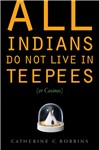
 Read the beginning of the Introduction, "Flying Together" from All Indians Do Not Live in Teepees (or Casinos) by Catherine C. Robbins:
"In 2006 the twelve bands of the Kumeyaay-Diegueño Nation raised a new national flag—their own—at Cabrillo National Monument on San Diego’s Point Loma. For the first time, their flag took its place alongside the banners of the nations that had invaded and gained control of their land: Portugal, Spain, Mexico, and the United States. Those had flown regularly for years over historic Point Loma during an annual ceremony marking the European American arrival that had begun five centuries before. Now a Native American nation that has called the area home for millennia hoisted its own standard. The Kumeyaay-Diegueño flag flew firmly in a stiff breeze that day, a signal of the love and sacredness that American Indians attach to an occupied and besieged homeland. It also demonstrated the return of Kumeyaays to a place where historians estimate they had first set foot between eleven thousand and thirty thousand years ago. With energy and dedication plus the inspiration of one of their respected elders, Jane Dumas, they had circled back to a place they had never really left.1*
This book reveals a similar and broader story unfolding across Indian Country. It begins with the 1999 repatriation of ancestral remains to Jemez/Pecos Pueblo in New Mexico. The return of two thousand bodies was the single largest repatriation to an American Indian group in history under the terms of NAGPRA, the Native American Graves Protection and Repatriation Act.2* The restoration of remains and cultural artifacts taken from Indian communities during centuries of European American occupation is more than a piece of legislation.
At its most basic, NAGPRA affirms a human right to maintain death rituals. But in its larger meaning, it has become a centripetal cultural force within Native America. Through repatriation, American Indians collect memories ripped out of their communities, bring them into the present, and use them to shape the future. Indians’ memories are not stuck in photo albums or digital recordings or on bookshelves. They are alive in still-told stories and the restoration of Native names for people, towns, and geographical landmarks.
As Indians collect ancestors, hope, joy, and savage nightmares into their lives, repatriation has expanded the significance of sovereignty. W. Richard West (Cheyenne), the founding director of the Smithsonian Institution’s National Museum of the American Indian (NMAI), asserts that repatriation is the most potent metaphor for cultural revival and political sovereignty.3* It expresses sovereignty as self-determination, a basic desire to be and to live as one wishes, a longing for a place on the land and in the cosmos.
What happened at Point Loma was a small symbolic flare-up of that yearning, which has never diminished even after centuries of occupation. The reinstatement of Jane Dumas and her people to prominence at Point Loma shows how repatriation drives contemporary American Indian life. The flag she inspired not only affirmed self-determination in the broad sense of the word but also mended a tear in memory’s fabric."
Catherine C. Robbins has spent twenty-five years as an independent journalist and writer, and her stories about American Indians have appeared in numerous publications including the New York Times.
To read a longer excerpt or to purchase All Indians Do Not Live in Teepees (or Casinos) , visit http://www.nebraskapress.unl.edu/product/All-Indians-Do-Not-Live-in-Teepees-or-Casinos,674879.aspx.
*Refer to the print edition for notes 1, 2, and 3.

