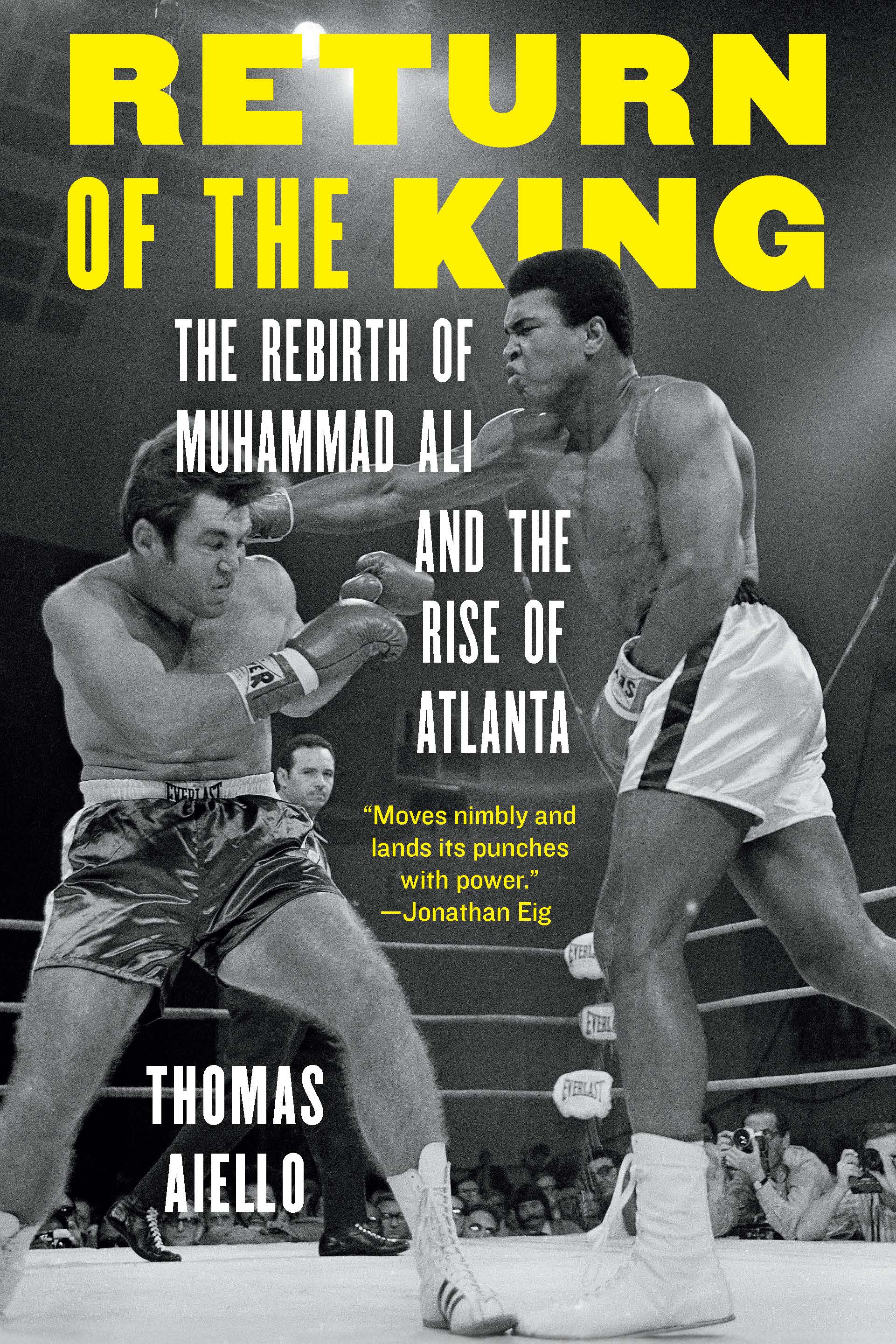
Thomas Aiello is a professor of history and Africana studies at Valdosta State University. He is the author of White Ice: Race and the Making of Atlanta Hockey and Dixieball: Race and Professional Basketball in the Deep South, 1947–1979. His most recent book Return of the King: The Rebirth of Muhammad Ali and the Rise of Atlanta (Nebraska 2025) was published in December.
Return of the King tells the story of Muhammad Ali’s return to the ring in 1970, after a more than three-year suspension for refusing his draft notice as a conscientious objector during the Vietnam War. With Ali’s career still in doubt, he found new support in shifting public opinion about the war and in Atlanta, a city still governed by white supremacy, but a white supremacy decidedly different from that of its neighbor cities in the Deep South.
Atlanta had been courting and landing professional sports teams in football, basketball, and baseball since the end of 1968. An influential state politician, Leroy Johnson, Georgia’s first Black state senator since Reconstruction, was determined to help Ali return after his exile. The state had no boxing commission to prevent Ali from fighting there, so Johnson made it his mission for Ali to make a comeback in Georgia. Ali’s opponent would be Jerry Quarry, the top heavyweight contender and, more important, a white man who had spoken out against Ali’s objection to the war.
In Return of the King, Thomas Aiello examines the history of Muhammad Ali, Leroy Johnson, and the city of Atlanta, while highlighting an important fight of Ali’s that changed the trajectory of his career. Although the fight between Ali and Quarry lasted only three rounds, those nine minutes changed boxing forever and were crucial to both the growth of Atlanta and the rebirth of Ali’s boxing career.
Prologue
On September 7, 1892, the Olympic Club of New Orleans hosted what it called a “fistic carnival,” the most important night of boxing in the United States to date. The bare-knuckle days were over, boxing was legal in Louisiana, and the heavyweight champion, John L. Sullivan, who had fought illicitly in the area several times prior, headlined the card, defending his title against James Corbett. The two could not have been more different. Sullivan had won his title ten years earlier, the last of the bare-knuckle champions. “Gentleman Jim,” by contrast, had trained with a coach and had only fought under the Marquis of Queensbury rules that now governed the sport. When the gentleman defeated the brawler, the world took notice. Boxing had changed forever.
But if it was the beginning of one era, it was the end of another. On the undercard of the heavyweight title fight between Sullivan and Corbett was another championship bout, this one for the bantamweight title. The champion was George “Little Chocolate” Dixon, a Canadian boxer, defending against a newcomer, Jack Skelly, making his first professional fight. Skelly came from Brooklyn and had a strong amateur background, but he wasn’t ready for a championship match. Dixon knocked him out in the eighth round. That a recognized champion defeated a debutante on the undercard of a major fight was not particularly newsworthy. But in this fight, the Canadian, Little Chocolate, was Black, and his Brooklyn opponent was white. By 1892, New Orleans was two years into its experiment with formal segregation, but though the Olympic Club was a white venue, the draw of Dixon did convince the club to allow Black fans to watch its “fistic carnival.” Those fans entered through a separate entrance and sat in a segregated section. But they were there.
When the night was over, white newspapers throughout the country blared headlines that Jim Corbett had defeated John L. Sullivan and won the heavyweight crown. Black newspapers, meanwhile, blared headlines that George Dixon had successfully defended his title by defeating a white opponent. The culture makers in New Orleans, while generally polite to the bantamweight champion, were horrified by what they had seen. White fans “winced every time Dixon landed on Skelly. The sight was repugnant to some of the men from the South,” the Chicago Tribune explained. “The idea of sitting quietly by and seeing a colored boy pommel a white lad grates on Southerners.” The New Orleans Times Democrat lamented that it was “a mistake to match a negro and a white man, a mistake to bring the races together on any terms of equality, even in the prize ring.” There would be no more interracial boxing contests in New Orleans, not in an era of social Darwinism, when boxing was an easy shorthand for evolutionary might, particularly for those who didn’t trouble themselves with science books. When another interracial bout was scheduled in Mississippi in 1897, a white man stepped in and stopped it. “The idea of n—s fighting white men,” he said, “Why, if that darned scoundrel would beat that white boy the n—s would never stop gloating over it, and, as it is, we have enough trouble with them.”
The Dixon-Skelly fight would be the first time a Black man pummeled a white man in front of a large crowd of onlookers in the Deep South without facing retributive incarceration or the hangman’s noose.
And it would be the last—for the next seventy-eight years.
——
Seventy-one years after the fistic carnival, the March 1963 edition of Ebony magazine arrived at the homes of hundreds of thousands of subscribers across the country with two feature articles, one profiling a new phenomenon in politics, the other a new phenomenon in sports. The first told the story of Leroy Reginald Johnson, the first Black state senator in Georgia since 1870 and the only Black state senator in the South, whose political success in another Deep South state would have been difficult to fathom as Skelly hit the mat in the eighth round back in 1892. The article closed with a quote from a member of Johnson’s team, describing the new senator’s electoral win. “This is a victory for the whole community, and not just for Negroes,” he said. “It was a good day for the race—the human race.”
Johnson was an Atlanta native, a Morehouse graduate who had gone to law school, established a private practice, then became a politician. He was aided by a powerful Black voting bloc in the city that provided the Black middle and upper class a measure of influence unavailable to many others in the Deep South. That bloc, buoyed by the elimination of Georgia’s county unit system, which judged representation by majority vote in a county rather than by individual districts, sent Johnson to the state senate in 1962. While he faced bigotry early in his new job, he was able to overcome it largely through a willingness to negotiate and compromise with his colleagues. He took that same attitude into the world of business, as well, expanding his reach and growing his profile not only in the city but throughout the state and nation as a new exemplar of modern Southern politics, even though most Black residents of Atlanta would have argued, despite Johnson’s success, that no modern Southern politics actually existed. Still, Johnson’s election was a watershed, opening the door for further Black representation in the state legislature in the next several election cycles. He had “no illusions about what one Negro can accomplish in an otherwise all-white legislature,” Ebony claimed, but “he thinks he can ‘alter the image of the Negro as conceived by so many Southern legislators.’”
On the edition’s next page was a profile of the next big sensation in boxing, made notorious partly for his skill in the ring and partly for his boastful rhetoric. A picture of the fighter screaming was at the top of the page next to the article’s title, “A Look at Cassius Clay: Biggest Mouth in Boxing.” Clay told the magazine about his greatness, about the surety that he could defeat heavyweight champion Sonny Liston. “There’re a lot of things I want to be in this fight game,” he told the magazine, “but I sure don’t want to be a Joe Louis. That is, I don’t want to have the income tax trouble he had. Man, you can’t fight or do nothing without peace of mind. I don’t want anything to take my mind off going straight up—up—up.”
That is exactly what he would do. A young Clay had begun boxing at age twelve and would rise through the amateur ranks to win the national Golden Gloves and ultimately the gold medal at the 1960 Rome Olympics. After that he would become professional, rising through those ranks, as well, until he defeated Sonny Liston in 1964 to become world’s heavyweight champion. In the ring after his victory Ali screamed into a microphone, “I’m the king of the world!” After defending that championship for three years, Clay would face scrutiny from the federal government; he would lose much of that peace of mind. And when he was no longer going straight up—up—up, he would eventually turn to Georgia’s Black state senator, who would restore much of that peace of mind and put his career back on its upward trajectory. The connection between the two was only cosmetic in 1963, but it would move from the pages of Ebony in 1970, and in the process would fundamentally change sports in the remainder of the twentieth century.

