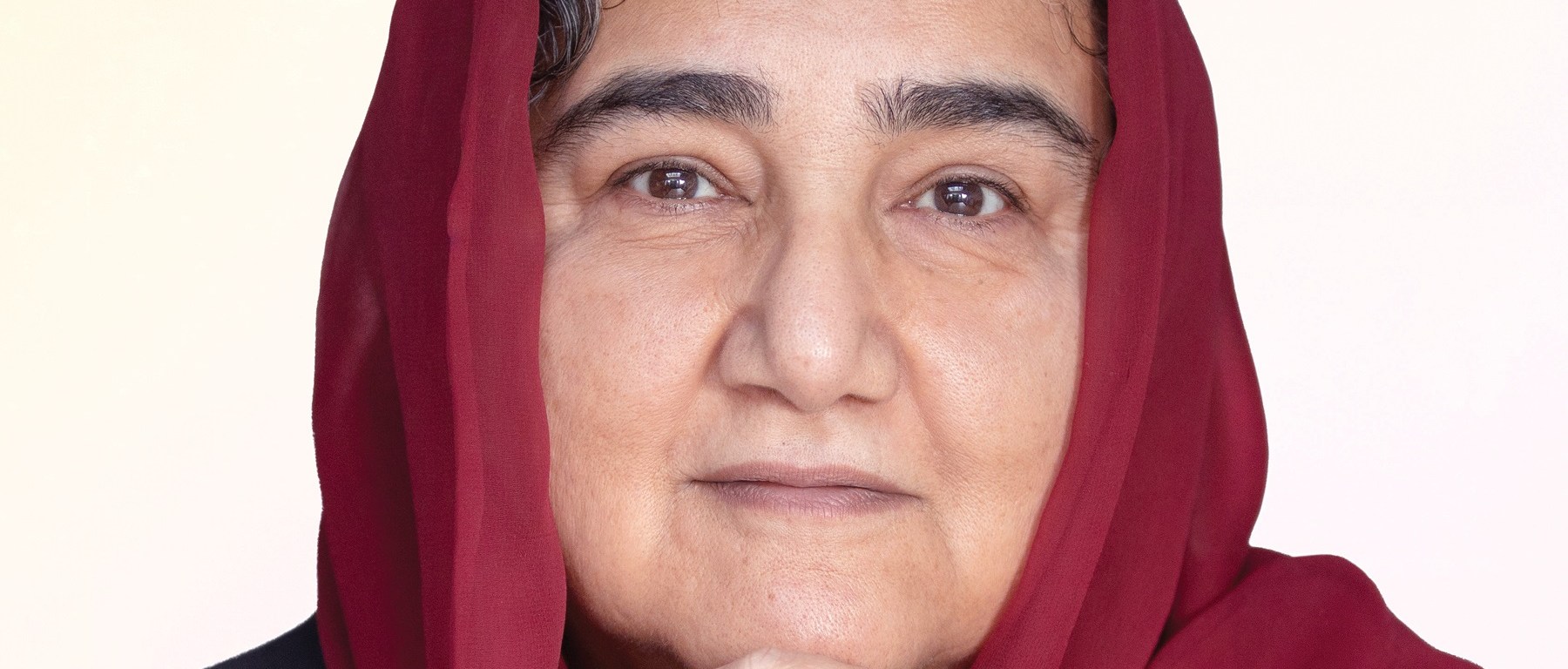
Marzia Babakarkhail was a judge in Afghanistan for seven years before becoming a member of the board and chair of the Women’s Committee of the Afghan NGO’s Coordination Bureau. Now living in the UK, she is a caseworker for a member of Parliament and is a lifelong women’s rights activist and advocate. Together with Pamela Say, she is author of Marzia: A Judge’s Fight for Afghan Women’s Rights, which takes readers on a heart-pounding journey through the stark realities of life under Taliban rule following the U.S. withdrawal from Afghanistan in 2021. Through vivid storytelling, Marzia brings to life the fear that gripped so many, as well as the resilience that carried her and countless others forward.
Her story is not merely one of survival, but also of determination and strength. It reflects the broader struggle faced by women throughout Afghanistan, particularly those in the legal system who risked everything to uphold the rule of law and protect others’ rights.
This is not just Marzia’s story—it is the story of a movement, of resistance, and of hope in the darkest of times.
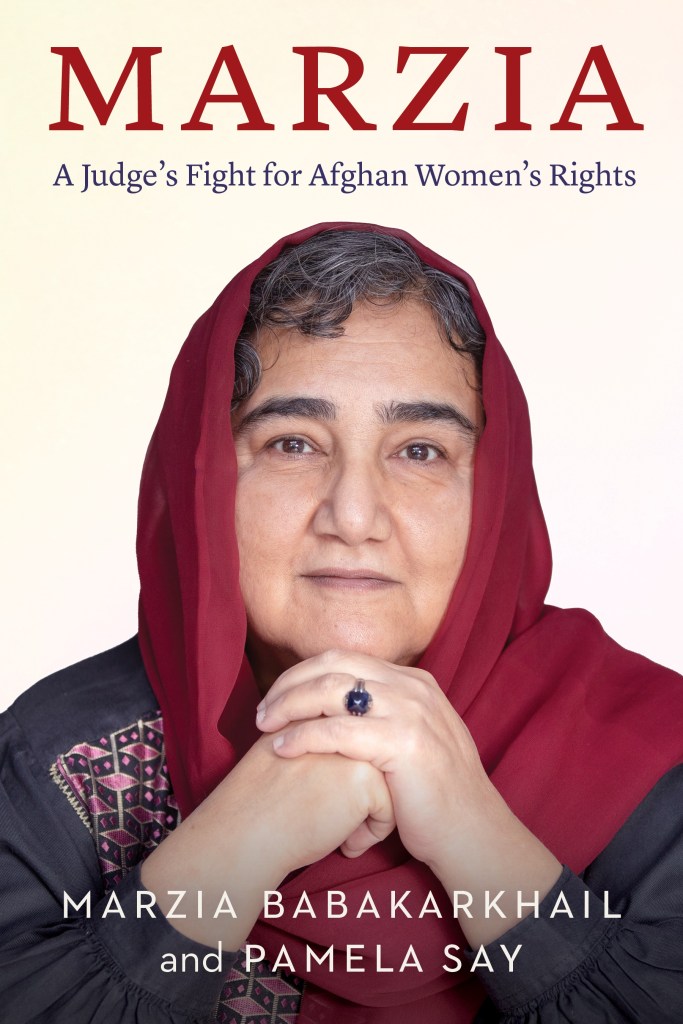
In 1997, the Taliban advanced on Northern Afghanistan, breaching the city of Puli Khumri where Marzia served as a judge and lived with her mother and young siblings. The Taliban made their first attempt on her life, forcing her to flee to Pakistan. As a refugee, Marzia founded the Goharkhatoon School in Peshawar and with her mother, sister, and colleagues, began educating Afghan refugee children. Khatima was one of her students.
My name is Khatima Emami. I was born in Peshawar, Pakistan. I do not recall exactly when I began school, but I believe I was about four years old. From an early age, I was deeply passionate about education and learning, regardless of the challenges. I have six sisters and one brother. All of my sisters attended Goharkhatoon School in Peshawar, and eventually my twin and I joined them there. I have beautiful memories from those early years, like flashes of photographs coming and going. Even though I was a kid, I still remember it.
Ms. Marzia Babakarkhail was the principal of our High School. I hold deep respect for her and consider her a mother figure. She was kind, talented, and committed to students’ academic success, but she was also known for her strict discipline. We admired her so much that we were also afraid of her. I would wonder why she was so strict. At the time, I did not know it was for my own good. If there were no restrictions, I would not have paid attention to my studies. Whenever she visited the school yard, all of us students would rush quietly back to our classrooms.
Her sister, Ms. Nahid, was my class teacher. She was incredibly kind and nurturing, and taught us with great care and affection. Ms. Marzia had established the school primarily to support Afghan refugee girls, offering education regardless of financial status. Her dedication to empowering young women left a lasting impression on my family and me. Even after we moved from Pakistan to Afghanistan during my later school years, we continued to maintain a strong relationship with her. After completing school in Afghanistan, I began working to support my family. I joined Tolo TV as a Commercial Marketing Coordinator. During that time, I decided to pursue higher education despite financial challenges. I applied for a scholarship through the Indian Embassy and was fortunate to receive one to study for a bachelor’s degree in arts (Political Science, Public Administration, and Human Rights) in India.
While completing my bachelor’s degree, I began thinking about pursuing a master’s degree. I learned about South Asian University (SAARC), a prestigious university in Delhi, India, offering advanced academic programs. My twin sister and I both applied for the entrance exam. Out of all the applicants from SAARC countries, only two seats were available per country. We were both selected; she earned the first seat, and I earned the second. However, due to our family’s financial situation, my sister chose to stay and work while I pursued my studies.
Convincing my mother to let me continue my education was not easy. She was heartbroken at the thought of being separated from me again. To help me gain her support, I reached out to Ms. Marzia, who has always been a source of inspiration. She encouraged me not to miss this opportunity, saying, “Chances don’t always knock twice. If you leave them, they are gone.” Her words gave me strength and confidence. With her support, I was able to persuade my mother to allow me to go.
At South Asian University, I earned my master’s degree in Sociology. During this time, I also began writing and publishing academic articles. My education opened many doors for me. After completing my degree, I joined a USAID project called Conflict Mitigation Assistance for Civilians, where I worked for two years. While working, I also began my PhD in Political Science (Political Thought) at Ferdowsi University in Iran. I balanced my time between working, studying, writing, and teaching at several universities.
Following the political takeover in Afghanistan, I relocated to the United States. Initially, I felt hopeless, believing I had lost the opportunity to grow as I did back home. However, I soon began working with the International Rescue Committee as a Mental Health Specialist. I was later promoted to Client Services and Education Business Coordinator.
Today, I am immensely grateful to my family and especially to Ms. Marzia, whose influence continues to shape my life. She played a critical role in my academic journey, and I aspire to follow in her footsteps to empower women, to serve my community, and to be a role model for others. I hope to one day work closely with her again and continue learning from her example.
 UNP blog