
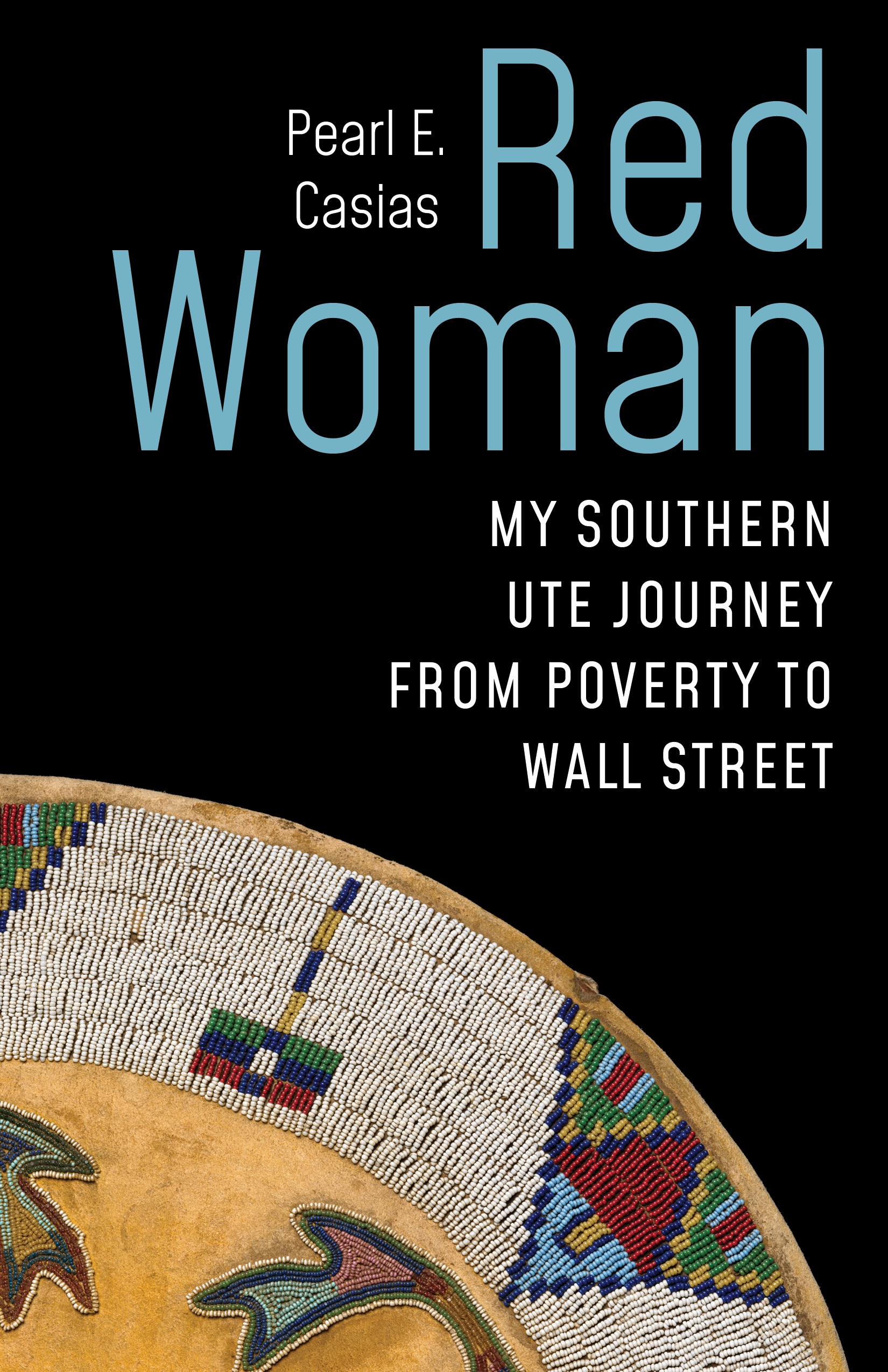
Pearl E. Casias served as the Southern Ute Indian Tribe’s chief judge for twelve years. She also served on the Southern Ute Indian Tribal Council and was the first woman elected chair of the tribe. Her new book Red Woman: My Southern Ute Journey From Poverty to Wall Street was published by Nebraska in June.
In this singular memoir, Pearl E. Casias tells the story of her rise from poverty to chair of the Southern Ute Indian Tribe in rural southwest Colorado. Casias grew up in poverty and was raised by alcoholic parents. She endured domestic violence in one of her marriages. Despite those dire periods in her life, she put herself through college and rose to become a Southern Ute tribal judge. She details her experience in the tribal court, whose jurisprudence is guided by Indigenous knowledge and Ute-centered spiritual rehabilitation.
With unflinching honesty, Casias lays out the problems confronting Southern Ute people, including the harm that centuries of colonialism have wrought on the reservation. Blending her personal story with that of her tribe, Casias describes how, as a tribal leader, she strove to develop positive cultural values within Ute society.
1
I was born in 1943 on the Southern Ute Indian Reservation in southwestern Colorado. My mother was full-blood Southern Ute, and my father was Spanish. They divorced when I was very young, and after that I lived with my maternal grandparents, my Aunt Pat, and my older brother, George, in a tiny two-room farmhouse on a mesa overlooking the Los Piños River. George and I used to ride our horses to the river to play in the cool, blue shadows of the San Juan Mountains. I have many happy memories of those early years with George.
Several times a month, Grandpa would saddle his horse, Too Grand, and Grandma’s horse, Lady Mae, and my brother and I would ride two miles into town with them for groceries and farm supplies. George was allowed to ride behind Grandpa, but Grandma always made me ride in front of her for safety, which made me feel special.
We bought food that we couldn’t raise ourselves. In the early years, my grandparents planted a huge garden every spring and kept enough animals to feed us through the winter. I remember wishing Grandma would buy some ice-cold milk in a bottle from the store, but she always purchased canned milk because it would keep longer.
I remember a grocery delivery driver from nearby Durango who used to dump his old produce on a hillside near our farm. George and I would sit on the hillside and wait for him to come by, then collect all the food and take it home to Grandma. She would carefully pick out the food that was good enough for human consumption, and any spoiled food would be fed to our pig, rabbits, chickens, or our pet geese, which we kept as watchdogs. It felt like a great adventure to us, and Grandma made many wonderful meals with that food. Nothing went to waste.
Grandma taught us where to find the best piñon nuts and how to harvest lamb’s-quarter and dandelion leaves for salad. She showed us where to gather herbs for a sore throat or an upset stomach. Our meals came straight from the garden during summer months, but in winter our food dwindled down to a few basics. We ate lots of jerky, cornmeal mush, dried cantaloupe, and fry bread soup, which was little more than bread dipped in coffee, canned milk, and sugar.
I remember being mostly warm and mostly comfortable. I didn’t know we were poor until Annie Weaver, Grandma’s niece, died of starvation. Her immediate family had long ignored her health and welfare, and by the time Grandma discovered Annie’s dismal living conditions, it was too late. Grandma moved Annie into a canvas tent near the hospital, but she died soon after. I was four or five when she died, and didn’t understand the problems that many in my family faced.
I grew up in a time when many healthy men went off to war and came home broken. My father was one of them. He walked out of our lives when I was four years old, and weeks later my mother left, too, in search of employment and a better life for us all. But not all plans are meant to be, and we never lived full-time with my mother again.
In the years that followed, my young life and the lives of those around me spiraled out of control. When I was six, my grandparents began to drink heavily, leaving my brother George and me to fend for ourselves. They were binge drinkers: They would manage to stay sober for weeks at a time, but once they started drinking, they would lose all control over themselves, their lives, and the safety and well-being of George and me. We learned very quickly to stay out of the way when the partying began.
We would hide out by the irrigation ditch or in the haystacks whenever they threw a party. George would sneak food, pillows, and blankets out of the house while I hid in the brush from the scary drunks inside. It was a confusing and frightening time for us both.
I learned to associate safety with solitude, and love with loneliness. I had only one person I could trust, and that was George, whom I thought of as a wise, old sage, though he was only ten.
When I look back at my life, I realize I was a neglected child and later an abused wife. I have been dirt-poor and have started over in my life more times than I care to count. But I’ve also been a tribal judge and an elected leader of my people. I’ve been charged with making million-dollar decisions that should sustain my tribe far into the future. I’m a proud mother, grandmother, and great-grandmother, and I see hope in the eyes of the younger generations that I never saw in my own.

