Settlers of Catan: November Triumphs and Defeats

Thursday, Nov. 7, 2013

The settlers: Shirley Thornton, Nathan Putens, Terry “the Bandit” Boldan, and I.

A small crowd gathered, warranting a small board. It was the smaller field of play that would lead to Shirley Thornton’s first victory in months. A sly one, that Thornton. She slowly built settlements, civilizations, and the longest road (uncontested); an abundance of resources seemed to flow her way. As a new member to the group of settlers, I'm told this is how she operates—with stealth and cunning, and a little bit of luck.

It was a long overdue win for Thornton, who claims her victories are few and far between, and not of her own volition. A humble one, that Thornton, and a strong settler nonetheless.

Much of Thornton's luck would come in the form of frequently rolled numbers of benefit to her. To a mathematician or statistician, this makes absolutely no sense, but as a group we’re convinced that one particular number will be rolled with greater frequency than any other for the course of a game. For this game, the most frequent number was 6. Thornton settled on the majority of land holding 6s. I’m not saying Shirley wasn't smart for settling where she settled, but 6s were rolled at an alarming rate.

Although Terry "the Bandit" Boldan played well, he was unable to corral the resources necessary to beat Thornton. He struggled to gain them. He wasn’t alone.

It was a relatively uneventful game for me considering I couldn’t procure the brick resource. This was owing to my lack of settlements on any brick-producing land (I had none), and there was little trade of the commodity. No one else seemed to have it either, although Nathan Putens and I forged a trade agreement on the grounds that he would send brick my way once he procured any. Unfortunately for me, he rarely did.
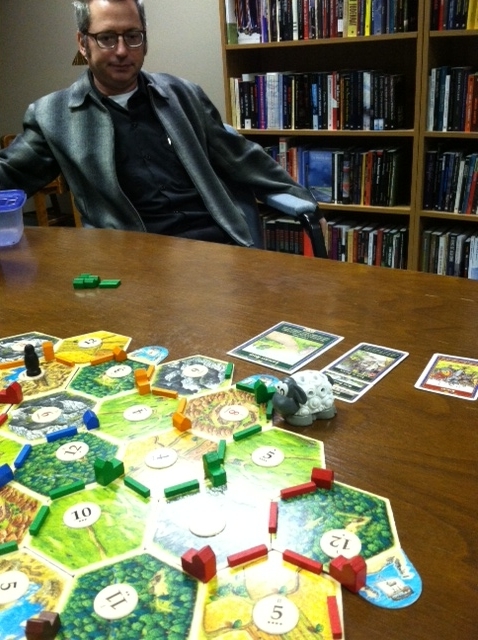
Terry wins_Nov 14Thursday, Nov. 14, 2013

The settlers: Terry “the Bandit” Boldan, Shirley Thornton, Nathan Putens, Erica Corwin, and I.

Terry Boldan isn’t called the Bandit for nothing. This week he terrorized the competition by drawing and playing a development card that would cause great devastation. Not too far into the game the entire bank supply of rock was depleted. That was when Boldan struck. Only he could invoke such craft, such sly tactics. The card he drew was the monopoly card, and in one fell swoop Boldan held all the rock resource the game could offer. With such surplus of one resource, Boldan made several moves that placed him well into the lead. This would obviously bring him victory.

Continue reading “Settlers of Catan: November Triumphs and Defeats”

UP Week: Future of Scholarly Communication

Thirty-seven presses will unite for the Association of American University Presses annual University Press Week blog tour, which runs November 11-15. Individual presses will blog on a different theme each day, including profiles of university press staff members, the future of scholarly communication, subject area spotlights, the importance of regional publishing, and the global reach of university presses.   Nov. 12, Future of Scholarly Communication  "Scholars at every level have unprecedented access to materials they once would have needed time and resources to consult. Remembering the days of waiting for a book or article that wasn’t in my university’s library, … Continue reading UP Week: Future of Scholarly Communication

Hanukkah Sale

Now through November 27, enter promo code 6CH13 to recieve 25% off select titles, just in time to celebrate Hanukkah.______________________________________________________________________________________ Seasons of Our JoyA Modern Guide to the Jewish HolidaysRabbi Arthur O. Waskow “Seasons of Our Joy brings reverent renewal to ancient practices. And it presents new understanding and approaches that we are invited to sanctify. This book will heighten your awareness of the eternal religious power of the Jewish calendar.”—Rabbi Gordon Tucker, former dean, Jewish Theological Seminary______________________________________________________________________________________A full list of titles eligible for the sale can be found on our website. Happy Hanukkah! Continue reading Hanukkah Sale

From the desk of Kevin Grange


GrangeKevin Grange is an award-winning freelance writer who has written for
 Backpacker Magazine, National Parks Magazine, and the Orange County Register, among others. He has been to Bhutan four times and has completed the Snowman Trek three times, including twice as a guide. He is author of Beneath Blossom Rain.

The call came at dawn on the morning of the twentieth day: “Wake
up, Sir!” my guide Namgyel exclaimed, tugging on my tent door. “She is out!

By “She,” Namgyel meant Gangkhar Puensum, the massive mountain that
straddles the border separating Tibet and the country I was hiking through, the
tiny Himalayan kingdom of Bhutan. At 24,829 feet, Gangkhar Puensum is not only
the tallest peak in Bhutan, it is also the highest unclimbed mountain in the
world. From the moment we arrived at our campsite the day before, Namgyel had had
the task of “mountain watching,” with strict orders from the head chef to fetch
us the moment Gangkhar Puensum appeared in view. I threw on my boots, grabbed
my coat and camera, and unzipped my tent door.

Bhutan is a small country, about half the size of Indiana, wedged
between India and Tibet. Along with being the world’s most mountainous country,
Bhutan has the distinction of being the last Buddhist kingdom in the Himalayas,
of not having a single traffic light, of being governed by a policy of “Gross
National Happiness,” and of having the toughest trek in the world. At 216
miles, including eleven high mountain passes (seven over 16,000 feet), Bhutan’s
epic Snowman Trek is a 24-day boxing match for the hiking boots. More climbers
have scaled Mount Everest than have finished the Snowman Trek. Historically
less than 120 people attempt the Snowman each year and, of those, less than half
finish. Just some of the challenges of the trek include its duration,
notoriously bad weather, long mileage, high camps, and high elevation—all of
which mean there is a high likelihood something will go wrong. However, a
lifetime of traveling has taught me that it’s precisely these types of crucible
situations that can reveal new aspects of your character and lead to new
discoveries.

Having had the good fortune of traveling to Bhutan four times, I’ve
noticed a number of changes in myself since my first trip. I once struggled
with greeting someone in Dzongkha, Bhutan’s national language,
and yet, saying kuzuzangpo-la now seems as effortless as hello in
English. I also now intuitively walk clockwise around stupas (Buddhist
monuments), praise the gods like a local by shouting “Lha Gyalo”
from the high mountain passes, and have the good gastrointestinal sense to
request Bhutan’s mild chilies with my meals. However, perhaps the most striking
change can be seen in the pictures of my visits to the “Land of the Thunder
Dragon.”

Continue reading “From the desk of Kevin Grange”